

The Digital Blueprint: Why AI Algorithms are Deeply "Attracted" to Local Business Directories
The Digital Blueprint
In the burgeoning digital age, Artificial Intelligence (AI) and local business directories might seem like two different worlds. One evokes advanced neural networks, machine learning, and automation, while the other brings to mind traditional online listings and local community searches. However, these two forces are increasingly intertwined, with local directories playing a crucial role in feeding the very intelligence that powers modern digital experiences. So, why do AI algorithms seem to have a significant "attraction" to local business directories? The answer lies in the rich, structured, and contextual data these directories provide.
1. A Structured Feast of Accurate Data
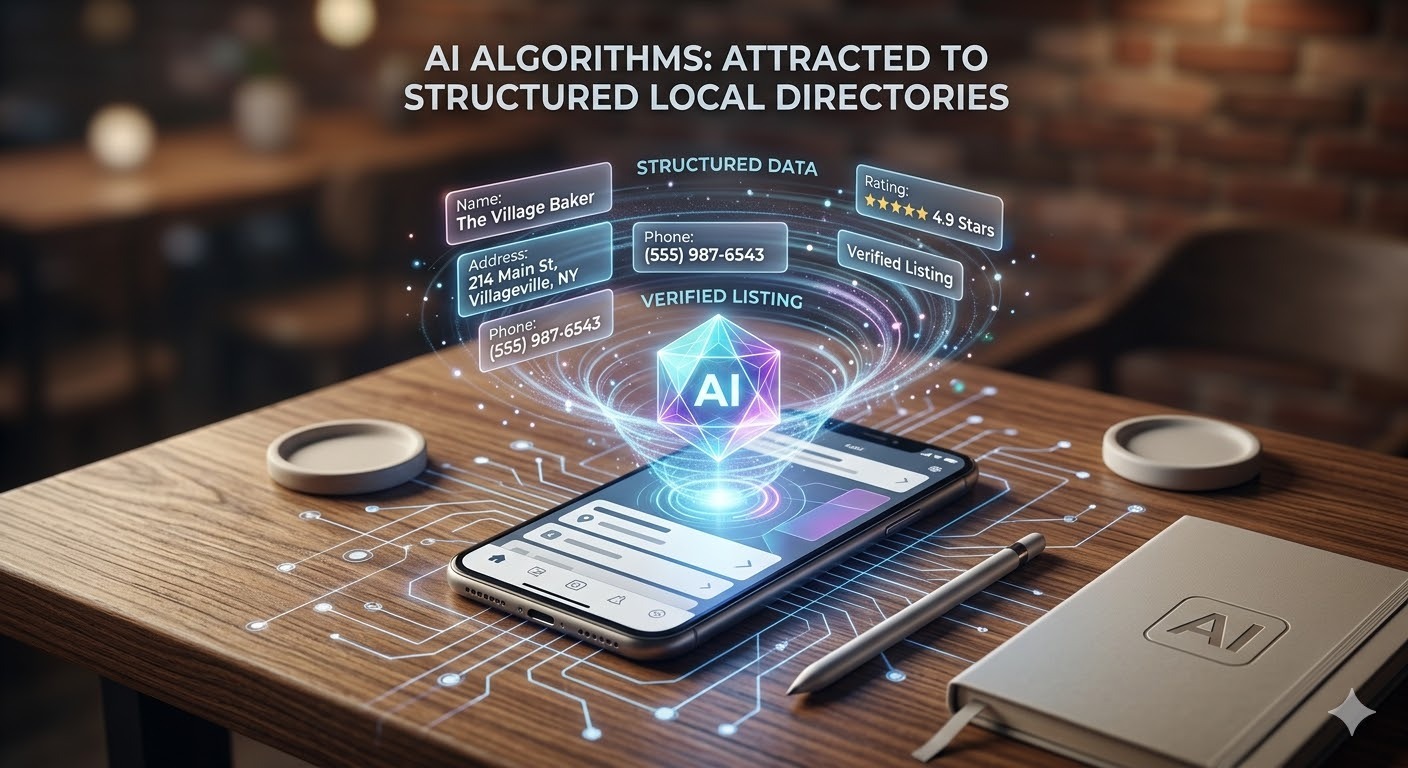
At their core, AI models thrive on high-quality, structured data. Local business directories offer a treasure trove of structured information, meticulously organized and categorized. Unlike a raw webpage, which requires a substantial amount of Natural Language Processing (NLP) to extract relevant facts, a local directory listing is already parse-ready. Every piece of data is neatly categorized. The entity is the business, and its attributes are clearly defined:
- N.A.P. (Name, Address, Phone Number): This is the holy grail of local data. AI algorithms need this foundational information to verify a business’s existence and legitimacy. When an AI agent (like Siri, Google Assistant, or an autonomous vehicle's infotainment system) is asked to find a local service, it relies on this core data.
- Operating Hours: This temporal data is vital. Knowing if a business is open right now is a key requirement for any responsive AI recommendation.
- Services and Products Offered: Detailed descriptions and categories help an AI understand a business's context and capabilities. This allows it to match complex user queries with the most suitable service provider.
- Categories and Tags: This hierarchical structure makes it easy for AI to understand the relationships among different business types (e.g., a "dentist" is a subcategory of "healthcare").
For an AI, this structured format is like having a perfectly curated library instead of a messy pile of books. It reduces the processing power and complex reasoning required to understand what a business is, where it is, and what it does, significantly improving the AI's efficiency.
2. A Signal for Trust and Authority
The digital world is vast, and verifying the accuracy of information is a challenge. Local directories provide a multi-layered signal of trust for AI algorithms. When an AI "sees" that a business’s N.A.P. data is consistent across dozens of high-authority directories, it’s a powerful validation. Consistency builds trust.
Furthermore, popular directories themselves have established authority in the eyes of larger platforms (like Google). When an AI model is learning about a specific market or area, a well-established directory serves as a reliable reference point. The presence of a listing on an authoritative site like Yelp, Yellow Pages, or TripAdvisor increases the likelihood that the AI will consider the business legitimate and prioritize it in relevant searches. This verification process is foundational for many applications, from map-based navigation to localized ad targeting.
3. Enhancing Semantic Understanding and Context
Modern AI is moving beyond simple keywords and embracing semantic search—understanding the intent and context behind a user’s query. Local directories are invaluable for training AI to grasp this nuance. Consider a directory listing. Beyond the standard facts, it often includes:
- Business Descriptions: These narratives provide rich, contextual text that NLP models can analyze to better understand a business's unique value proposition.
- Photo and Video Content: AI is increasingly visual. Analyzing the images associated with a listing allows an AI to infer a business’s atmosphere, target audience, and quality. A luxury restaurant and a family-friendly diner will have different visual signals.
- Customer Reviews (and Business Responses): This is a goldmine for sentiment analysis. Beyond just star ratings, AI algorithms can process the actual words to understand what customers love (or dislike) about a business. This allows for highly nuanced recommendations (e.g., "Find me an Italian restaurant with a great patio for date night"). Analyzing how a business responds also builds a profile of its customer service philosophy.
These rich, additional layers of data transform a business listing from a simple data point into a multi-dimensional entity that an AI can understand in a human-like way.
4. Bridging the Digital and Physical Worlds
The final piece of the puzzle is location. In a world of increasing mobility, AI must be able to bridge the digital realm (queries, data) with the physical world (geographic coordinates, tangible services). Local directories are the conduit.
By geocoding every listing, local directories place every business on a precise physical map. This allows for proximity-based recommendations, which are the cornerstone of mobile AI. When a user asks, "Where is the nearest cafe?" the AI isn't guessing; it’s using a local business directory's spatial data to generate a real-time, accurate response. For self-driving cars, a directory-derived map of local businesses could be critical for understanding safe places to park or pull over.
Conclusion: A Symbiotic Relationship
The "like" that AI algorithms have for local business directories is highly functional. It is a dependency born from the AI's need for high-fidelity, structured, and contextual data. By providing accurate, consistent, and richly detailed information about local businesses, directories empower AI to provide faster, more accurate, and more relevant services. From smart speakers to search engines, AI models use directories as their localized truth. As AI continues to integrate into our daily lives, the importance of this well-curated database of the physical, commercial world will only grow, solidifying a powerful and symbiotic relationship between technology and local community commerce.